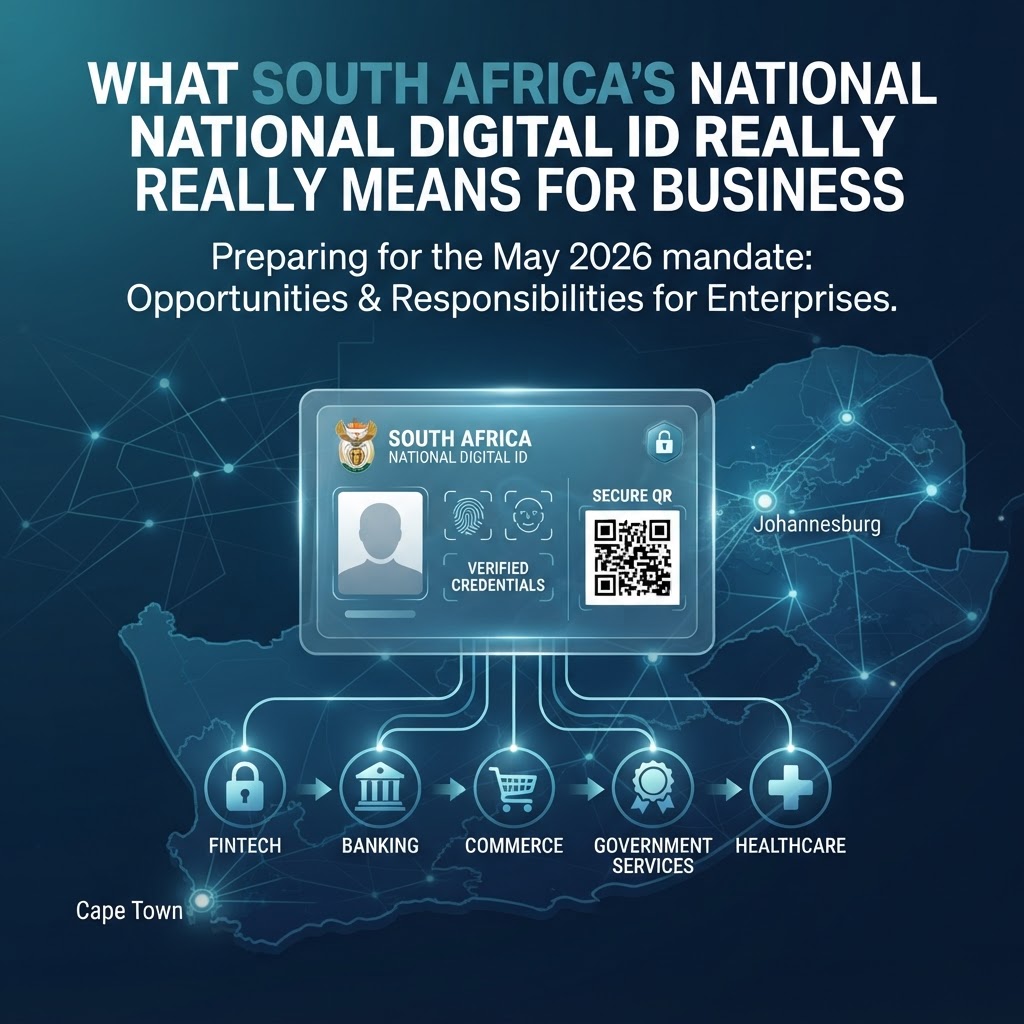
What South Africa's National Digital ID Really Means for Business
South Africa's Digital ID Is Coming - What It Means for Businesses and Why Verifiable Credentials Are the Missing Piece
South Africa is on the edge of a real identity shift. In May 2026, the Department of Home Affairs gazetted draft regulations that would introduce a national Digital Identity system - allowing citizens to store and use secure digital versions of their ID documents directly on their smartphones, verified through facial biometrics.
This isn't some distant policy vision. The Department of Home Affairs has set a 31 March 2027 deadline to complete the hosting infrastructure, with the full platform due to come online in 2027/2028. That's the first financial year in which South Africans will be issued with verifiable digital credentials via a secure mobile wallet.
For businesses, this isn't something to observe from the sidelines. It's an invitation to get ready.
What the Draft Regulations Actually Propose
The draft regulations propose digital identity credentials that will sit alongside physical products like your Smart ID card. Citizens will be able to store secure digital versions of their identity document, birth certificate, marriage certificate and other Home Affairs documents directly on their smartphone, with the ability to remotely confirm their identity using biometric verification.
Importantly, use of the system will be completely optional. Physical Smart ID cards aren't going anywhere.
Under the hood, the system will rely on a digital identity stack comprising PKI (Public Key Infrastructure), a certificate authority, digital verifiable credentials issued by authorised institutions, and digital wallets secured by biometric authentication, PIN-based access and cryptographic validation. Where connectivity is limited, QR-based and Smart ID card hybrid mechanisms will support offline authentication.
The security design is robust. Think face-matching to confirm you're a real, live person, fingerprint checks to prevent duplicate identities, and encrypted digital documents that simply can't be faked.
South Africa Is Leapfrogging - Not Catching Up
It would be easy to read this as South Africa playing catch-up with more digitally mature economies. But that's not quite the right framing.
By moving directly to a mobile-first, biometric-authenticated model, South Africa is skipping the legacy infrastructure headaches that have slowed many developed nations. The EU has spent years and significant investment getting to a point where every member state must provide citizens with a Digital Identity Wallet by the end of 2026. South Africa is arriving at a very similar destination by a more direct route.
That's actually something to feel good about. We're not trailing - we're moving with clarity and intent at exactly the right moment.
The Business Opportunity - and the Elephant in the Room
Here's where businesses need to pay close attention.
The draft regulations describe the government's role as the issuer and the citizen's role as the holder reasonably well. But as industry specialists have noted, the draft says almost nothing about verifiers - the banks, retailers, security companies and government departments that will need to read and trust those credentials when citizens arrive at their door.
That gap is where private sector innovation needs to show up. Businesses that want to accept, verify and act on digital credentials will need to be ready before their customers are.
At IYAM Digital, this is precisely the ecosystem role we're built for. Our platform enables organisations to act as verifiers and issuers within a trusted digital identity ecosystem - onboarding individuals, validating credentials biometrically, and completing that verification loop in seconds rather than days.
What This Means for Your POPIA Compliance
One thing specialists have genuinely welcomed in the draft is the principle of data minimisation. The regulations state that a credential "may encode only such mandatory particulars... as are necessary for the lawful verification purpose for which the credential is presented."
In plain English: a bar can confirm a patron is over 18 without ever seeing their date of birth or ID number. A hotel can verify a guest's identity without storing a copy of their passport.
This is good privacy practice - and it maps directly to what POPIA requires. Verifiable credentials are designed to work exactly this way. They give individuals real control over what they share and with whom, while giving businesses a legally defensible, audit-ready identity record - without the liability of holding raw personal data in centralised databases that can be breached.
The Bigger Picture: Verify Once, Use Everywhere
South Africa's national initiative is arriving at a moment when this kind of thinking is gaining serious global momentum. Digital wallets are empowering individuals to manage and share their identity attributes directly, on their own terms. That shift reduces risk exposure for businesses, aligns with data protection laws, and - perhaps most practically - removes the friction that currently makes identity verification slow and frustrating for everyone involved.
The direction is clear: businesses that thrive in this new landscape will be those that treat identity as a reusable asset rather than a repeated hurdle. For customers, that means less friction at every touchpoint. For businesses, it means faster onboarding, lower fraud rates and genuinely lower compliance overhead.
What You Should Be Doing Right Now
The national digital identity system won't be fully operational overnight. But the window between now and the 2027/2028 rollout is valuable preparation time - and it moves quickly. Here's where to start:
- Understand the issuer-holder-verifier model. Your business will most likely operate as a verifier - receiving and validating credentials that your customers hold. Getting comfortable with what that means technically and legally puts you well ahead of your peers.
- Audit your current KYC and onboarding processes. Identify where identity verification is slow, expensive, or creating compliance exposure. Those are exactly the pain points verifiable credentials are designed to solve.
- Align with the standards early. The draft regulations reference international standards including OpenID Connect for verifiable credentials. Aligning your technology choices now avoids costly rework down the line.
- Don't wait for the national system to get started. Private ecosystems in travel, education, healthcare, HR and financial services are live today. You can start realising the benefits of verifiable credentials right now.
The Bottom Line
South Africa's digital identity future isn't coming - it's taking shape. The regulatory framework is being drafted, the infrastructure is being built, and the technology to support it already exists in mature, deployable form.
The businesses that engage now - understanding verifiable credentials, aligning with POPIA-compliant identity architecture, and getting ready to act as trusted verifiers - will have a meaningful head start when the national system goes live.
That's what IYAM Digital is here for. Whether you're onboarding staff, verifying customers, or managing access across physical and digital environments, our biometric-enabled verifiable credential platform is the practical bridge between where your business is today and where South Africa's identity ecosystem is heading.
Want to understand how this works for your specific business? [Get in touch with the IYAM Digital team.]