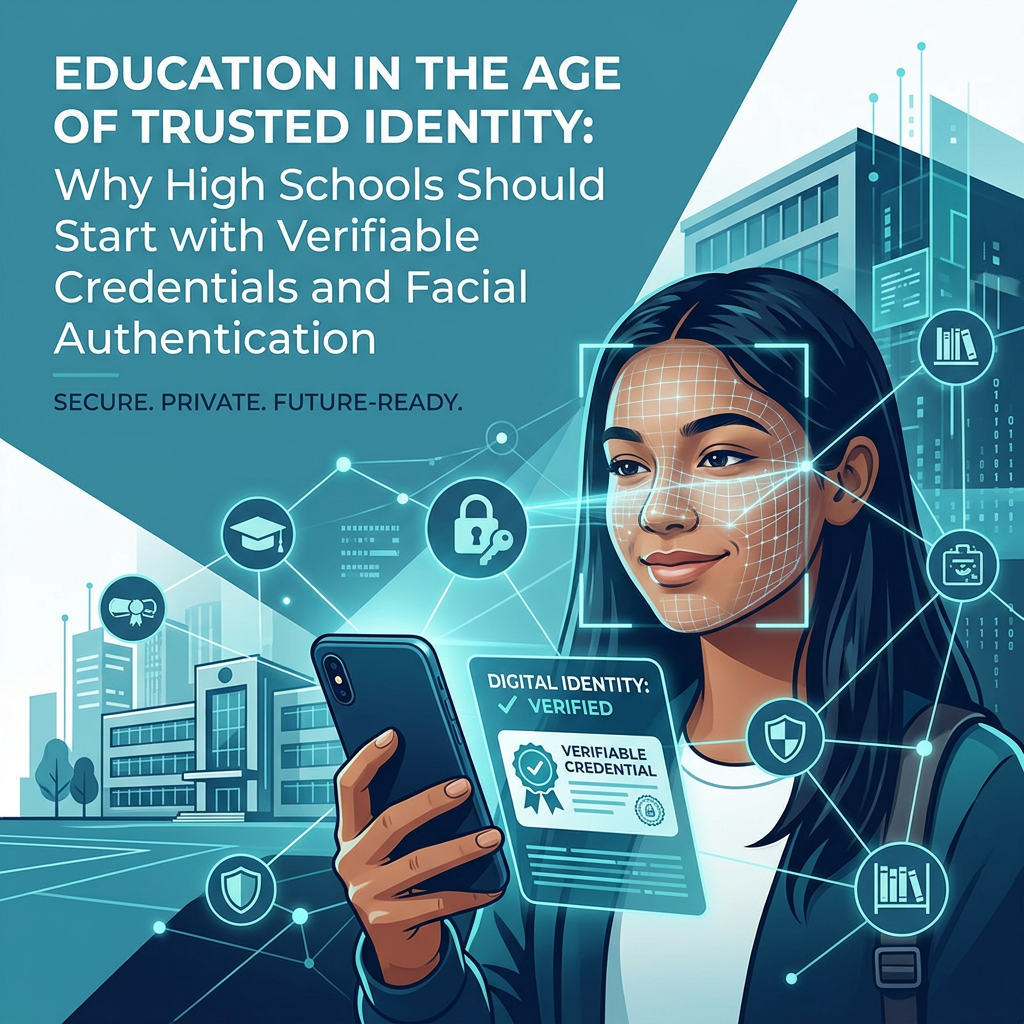
Transforming Student Identity with Verifiable Credentials
Education is undergoing rapid digital transformation. Learning platforms, digital classrooms, online assessments, and remote collaboration are now part of everyday school life.
But one critical component remains surprisingly outdated: student identity and credentials.
Schools still rely heavily on passwords, plastic cards, paper certificates, and manual verification processes. These systems create friction, increase administrative burden, and introduce growing risks around fraud, security, and trust.
As education becomes more digital, identity must evolve too.
This is where Verifiable Credentials combined with facial authentication offer a powerful new model for high schools.
The Identity Problem in Modern Schools
Today, schools are responsible for more than education. They manage:
- Student identity
- Attendance and safety
- Academic credentials
- Digital platform access
- Exam verification
- Extracurricular achievements
Yet these systems are often disconnected and difficult to manage. Students forget passwords. Cards are lost. Certificates are misplaced. Academic records require manual verification.
Most importantly, learners graduate without a trusted, portable digital identity that reflects their achievements.
In a digital-first world, that’s becoming a significant gap.
Verifiable Credentials: A Digital Record That Learners Own
Verifiable Credentials allow schools to issue secure, digitally signed achievements that students control and store in their own digital wallet.
These credentials can include:
- Academic performance
- Subject achievements
- Sports participation
- Leadership roles
- Skills and competencies
- Awards and recognition
Unlike traditional certificates, these credentials are cryptographically secure and instantly verifiable. Universities, employers, and training institutions can confirm authenticity without needing to contact the issuing school.
This reduces fraud, simplifies administration, and gives learners ownership of their achievements.
But to make this truly effective, credentials must be tied to trusted identity.
Why Facial Authentication Matters
Verifiable Credentials confirm what a learner has achieved.
Facial authentication confirms who the learner is.
When combined, they create trusted, verifiable student identity.
Facial authentication enables:
- Secure login to school platforms
- Credential access and sharing
- Exam identity verification
- Attendance confirmation
- Digital campus services
Students no longer rely on passwords or cards. Their identity becomes secure, simple, and frictionless.
More importantly, facial authentication ensures that credentials remain securely tied to the rightful owner, preventing misuse or impersonation.
Practical Applications in High Schools
The combination of Verifiable Credentials and facial authentication unlocks immediate, practical value.
Digital Student Identity from Day One
Learners receive a verified digital identity when they enter high school. This identity becomes the foundation for:
- Platform access
- Academic records
- Achievements and credentials
- Secure authentication
- Attendance recording
This identity grows with the learner throughout their school journey.
Trusted Digital Credentials
Schools issue Verifiable Credentials for:
- Academic achievements
- Extracurricular participation
- Leadership roles
- Skills development
- Attendance milestones
Each credential is securely linked to the learner’s verified identity.
Simplified Administration
Schools benefit from:
- Reduced password management
- Less manual attendance
- Faster verification processes
- Reduced credential fraud
Administrative teams spend less time managing identity and more time supporting learners.
Exam and Assessment Integrity
Facial authentication can verify learners during:
- Online assessments
- Digital examinations
- Coursework submissions
This strengthens academic integrity while supporting digital learning models.
Privacy and Responsible Design
Introducing facial authentication in education must prioritise privacy and learner protection.
Modern approaches emphasise:
- Privacy-preserving facial authentication
- Minimal data storage
- Learner-controlled credentials
- Clear consent frameworks
- Secure, decentralised identity models
The goal is not surveillance - it is trusted, user-controlled identity.
Building a Lifelong Digital Identity
The real value emerges over time.
A learner’s journey could look like this:
Grade 8
- Digital identity issued
Grade 9–11
- Achievements and skills credentials added
Grade 12
- Verified matric credential issued
Post-school
- Credentials shared with universities or employers
Early career
- Additional credentials added
Learners graduate not just with results - but with a trusted digital identity that grows with them.
A Natural Evolution for Education
Schools are already digitalising learning. The next logical step is digital identity and trusted credentials.
Verifiable Credentials combined with facial authentication:
- Reduce friction
- Improve trust
- Strengthen security
- Empower learners
- Future-proof education systems
This is not a distant concept. The technology exists today.
The opportunity now is to bring trusted identity into education - starting with high schools - and giving learners ownership of their achievements from the very beginning.
Because in a digital world, trusted identity becomes as important as education itself.